
How Thick Can A Fiber Laser Cutter Cut?
Time : Nov 12, 2026 View : 1
Every plate RFQ we get opens with thickness. How thick a fiber laser cutter can cut is the first thing buyers ask, and the metal decides the answer. A 6 kW head is one thing. A 12 kW head with the thick-plate option is quite another.
How Thick Can a Fiber Laser Cutter Cut?
The maximum cutting thickness of a fiber laser cutter depends on its power, the material being processed, and the required cutting quality.
The biggest industrial systems push into the 50 mm range and, in specific setups, beyond. But that’s one number from one plate, not a figure you can bank on. The metal moves it.
Fiber Laser Cutting Thickness by Material and Laser Power
A starting reference:
|
Laser Power |
Mild Steel |
Stainless Steel |
Aluminum |
|---|---|---|---|
|
6 kW |
25 mm |
25 mm |
25 mm |
|
9 kW |
30 mm |
40 mm |
30 mm |
|
12 kW |
30 mm |
40 mm |
30 mm |
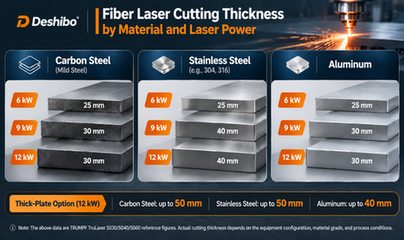
Those rows are TRUMPF figures for the TruLaser 5030/5040/5060 line. They describe one equipment line, not a promise for every cutter at the same power. Fit the thick-plate option to a 12 kW system and it reaches 50 mm in carbon steel. Stainless goes to 50 mm as well. Aluminum stays lower, at 40 mm.
Fiber Laser Cutting Thickness for Carbon Steel
Carbon steel is the metal our lasers see most. We cut it with oxygen, and the reaction does a lot of the work. That’s what pushes it past 20 mm.
Suppose your frame is 25 mm. A 6 kW head will cut it, but slower, with more dross under the edge. At 30 mm the cleanup shows in the price. Send the drawing and we’ll tell you where.
Fiber Laser Cutting Thickness for Stainless Steel
Stainless gets cut with nitrogen. Oxygen would stain the edge, and a grinder would have to follow. Nitrogen keeps the edge clean enough for weld or paint.
Thick stainless wants real power and gas pressure behind the beam. We’d start a thick 304 or 316 job at 9 kW or 12 kW.
Fiber Laser Cutting Thickness for Aluminum
Aluminum takes heat away from the cut readily, and it reflects part of the fiber wavelength. That’s why the usable thickness sits under the carbon steel figure at the same power.
A rough exit edge is the first sign the setup is off.
What Factors Affect Fiber Laser Cutting Thickness?
Laser Power
Power is how deep the cut goes. A 3 kW head handles 10 mm of carbon steel, then it runs out. 6 kW covers 25 mm. 12 kW works into the 40–50 mm range with the thick-plate option.
Material Properties
The same 10 mm cuts cleanly in carbon steel. Stainless runs between the two. Aluminum fights back, so we re-check the setup. Put "304" on the drawing, not just "stainless."
Cutting Speed and Focus Position
Speed sets how long the beam sits on one spot of the kerf. Run 20 mm stock too fast and the cut stops short of the bottom. Let the focus drift and the exit edge comes rough on the far side. We check both before a thickness is held in production.
Machine Configuration
The nozzle sets how much nameplate power reaches the plate. On thick-plate jobs we inspect the setup, not just the rating.
Maximum Cutting Thickness vs. Practical Production Thickness
The maximum is a demonstration number. One plate, one good pass, nobody watching the clock. The practical number is what we run shift after shift on the same machine.
Take a 6 kW head to its 25 mm ceiling and the speed slows off. The edge takes on roughness. Dross hangs under the cut. That thickest part can cost more than one cut a step thinner. The thickest material a laser can cut is not always the thickest material it can cut efficiently and consistently.
How Do Assist Gases Affect Fiber Laser Cutting?
Oxygen-Assisted Laser Cutting
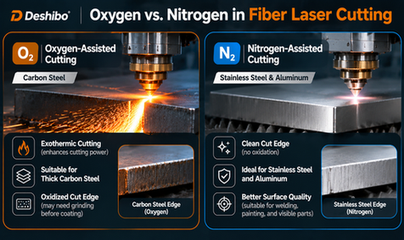
Carbon steel runs on oxygen. The jet burns the melt through, and the reaction heat pushes the cut through thick plate. You do get an oxidized edge. Parts headed for powder coating may need it ground first.
Nitrogen-Assisted Laser Cutting
We run stainless and aluminum on nitrogen. The edge comes off clean, provided the gas pressure and parameters are right. The gas bill also lands on the cost of every part.
Is Fiber Laser Cutting the Best Choice for Thick Metal Plates?
Plasma and flame cut heavy plate cheaper per square meter. A straight cut through 40 mm of plate is often plasma work.
A 40 mm gate frame? Plasma. A control cabinet with tight internal geometry? Laser. Which process fits comes down to the plate, the tolerance, and the budget. A fabricator that runs several processes can sort it out, including the sheet metal bending that follows the cut.
How to Choose a Reliable Fiber Laser Cutting Manufacturer?
Working with an experienced metal fabrication manufacturer can help ensure that your parts meet both technical and production requirements. Before you commit, we’d want to see:
The actual laser equipment, not the brochure numbers.
The maximum thickness for your material, confirmed.
A sample cut measured against your tolerance.
Bending and finishing under the same roof.
Why Choose Deshibo for Custom Metal Laser Cutting?
Advanced Laser Cutting Capabilities
TRUMPF laser equipment does the cutting here, with a published carbon steel capacity of up to 50 mm. The figure is configuration-specific.
Integrated Metal Fabrication Services
Sheet metal fabrication, CNC machining, laser cutting and bending, metal welding, and powder coating sit under one roof. Heavier features go through the CNC machining service, and welded subassemblies run as custom sheet metal welding parts before finishing.
Custom Manufacturing from Prototype to Production
Send your drawings and CAD files as they are. A prototype run and a volume run both work on the same setup.
Frequently Asked Questions
1. Can a 6kW Fiber Laser Cut 20mm Steel?
In carbon steel, yes, with the right configuration. Name the metal and the edge requirement on the drawing. At 20 mm, stainless and aluminum usually ask for more gas pressure.
2. Can a Fiber Laser Cutter Cut Thick Stainless Steel?
Yes. High-power equipment with the right assist gas handles thick stainless. 9 kW or 12 kW is where we’d start.
3. Does Higher Laser Power Always Mean Better Cutting Quality?
No. Power is one input. The same power cuts a better edge when focus and speed are set for the stock.
4. What Is the Best Thickness for Fiber Laser Cutting?
Start with the material and the equipment, then the precision you need. We’d run at 60–80% of a machine’s maximum. That’s where quality and cycle time hold.
Conclusion
Power limits how deep the cut goes. The metal sets the sweet spot.
Match the equipment to the plate, and keep a partner who takes the part to the end. Need custom metal laser cutting for your project? Contact Deshibo Machinery today and send us your drawings to discuss your material, thickness, and manufacturing requirements.
