
How Sheet Metal Nesting Improves Laser Cutting Yield and Part Quality
Time : Nov 19, 2026 View : 0
A sheet comes off the laser table looking clean. The tally: barely sixty percent usable, the rest offcut. Parts packed too close run hot; small pieces shift mid-cut. Neither problem starts at the laser. Both start with the layout — every profile’s position, its orientation, the order the beam reaches it. That layout work is sheet metal nesting. Done well, it raises laser cutting yield and material utilization, and keeps part quality steady.
What Is Sheet Metal Nesting in Laser Cutting?
Understanding the Sheet Metal Nesting Process
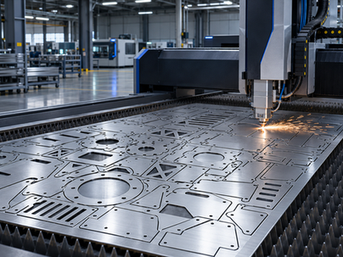
Nest a sheet the way you pack a moving van: big parts first, small ones in whatever is left. Each part needs room for its shape, the kerf, and breathing space; CAD/CAM nesting software keeps moving profiles until the sheet stops taking parts.
Why Nesting Matters in Metal Fabrication
You pay the same for a plate whether it yields six parts or twelve; nesting claws the difference back. Spacing does more than save material — it anchors small pieces and stops heat stacking.
How Sheet Metal Nesting Improves Laser Cutting Yield
Maximizing Material Utilization
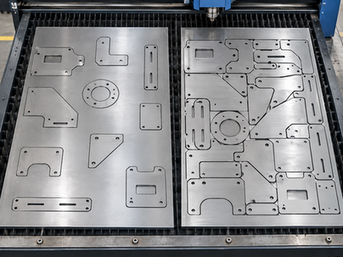
The trick is tiling — long edges against long edges, corners into whatever gap the neighbors leave. Software packs big and small together without breaking safe cutting distances. The measure: part area over sheet area, as a percentage.
Reducing Scrap and Production Costs
A better nest leaves less — leftover that tends toward strips fitting the next batch. Pull more parts from each plate and the cost per part falls; that is the whole argument for nesting. In sheet metal fabrication, that is where the cost curve bends.
Improving Cutting Efficiency
A nest sorted by position and sequence keeps travel short; in sheet metal laser cutting, head movement is half the cycle time. It is the flow a well-run laser cutting and bending operation keeps — and the difference a dependable CNC laser cutting service runs on.
How Sheet Metal Nesting Improves Part Quality
The layout also sets the thermal and mechanical conditions of the cut.
Minimizing Heat Distortion
The laser puts its heat in a small zone — the cut, plus a few millimeters around it. One part alone dissipates it; six packed tight do not. Each cut lands on metal still hot from the last; the plate warps, and parts near a crowded center drift. Give the heat somewhere to go. Spacing is that somewhere, and alternating dense and open zones keeps the warping down.
Maintaining Dimensional Accuracy
Keep the parts tied to the sheet by solid webs and the plate will not flex through dense geometry. Spacing gets sized against the kerf — cut width off the drawing, clearance wide enough that no edge kisses its neighbor. Repeated components hold the same tolerance band, sheet after sheet.
Improving Edge Quality and Surface Finish
Burrs usually start in the first millimeter of a cut. Lead-ins and lead-outs that sit in the offcut, never on a finished edge, keep dross and burr out of the part that ships. Finished edges kept apart stay free of spatter; a floating small part can tip up and mark whatever it hits. Power, speed, and assist gas still do the fine work. No nest rescues a bad parameter set.
Key Factors to Consider When Optimizing Sheet Metal Nesting
Part Geometry and Spacing
Geometry sets the limits: angular profiles tile differently from curved ones, and holed parts need more clearance than solid plates. The gap has to cover the kerf plus a thermal margin — too tight, and it saves millimeters, then pays for rework on every part.
Cutting Sequence and Part Orientation
Sequence usually wins over position. A head that sweeps the sheet in one steady pass beats a program that bounces it back and forth to save a centimeter of gap. Rolling direction shows up in finish and forming — parts bound for bending or polishing get a deliberate orientation. Thin skeleton webs are another failure: the plate stops supporting its own weight.
Nesting Software and Automation
Feed one job into CAD/CAM nesting and the rotation, grouping, gap checking, and path optimization finish in minutes. The result is a local optimum — tightest pack found, and tight is not the same as clean. An engineer’s review of sequence and skeleton catches that; it is the difference you notice at any custom laser cutting service that runs precision laser cutting on schedule.
How Material Type and Thickness Affect Nesting Optimization
Stainless Steel, Aluminum, and Mild Steel
Mild steel is the easy one — fast to cut, cheap to buy — so its nests simply run at maximum density. Aluminum dumps heat quickly, which keeps distortion down, but the cutting behavior moves around with alloy and thickness. Stainless steel wants the most care — edge and surface condition both matter, and on a crowded sheet the spacing and sequence stop being optional.
Choosing the Right Nesting Strategy
Run two thicknesses on one sheet and the machine stops to change parameters between them. A workable nest groups parts by grade and thickness, one region per parameter set. Deshibo Machinery builds that split into the sheet plan; stainless, mild steel, aluminum, and brass may share a week, but not a region.
From Optimized Nesting to High-Quality Finished Metal Parts
Integrating Nesting with the Sheet Metal Fabrication Process
Drawing review, cutting, deburring, bending, welding and assembly, finishing and inspection — the nest has to hold up through all of it. The usual failure is the profile packed tight against a bend line: it cuts fine, then forms wrong. Before the sheet runs, the layout gets checked against the bending allowance rules. The nest also leaves room for weld access.
Why Choose an Experienced Sheet Metal Fabrication Partner?
Who keeps those assumptions honest? The layout assumes a bend tool that holds angle, a weld that does not move geometry, and a finish that lands where the drawing says. At Deshibo Machinery the cut, forming, and finish move through one workflow, with engineering support from the first prototype into repeat production. The laser, press brake, weld cell, and CNC machine share a single schedule.
Conclusion: Optimize Your Laser Cutting Process with Better Nesting
Better nesting pays before the first cut even starts. The sheet yields more parts, the program runs tighter, and the parts stay consistent. Send the CAD drawings, material specifications, sheet thickness, and project requirements to start the review. The Deshibo Machinery team will assess feasibility and shape a fabrication plan.
Frequently Asked Questions About Sheet Metal Nesting
1. What Is the Main Purpose of Sheet Metal Nesting?
To fit as many parts as the sheet can support — right orientation, right spacing, in an order the machine runs cleanly.
2. Does Sheet Metal Nesting Improve Laser Cutting Accuracy?
Not directly. What changes is how heat builds: right spacing and sequence keep the sheet flatter and the parts from drifting. The machine’s tolerance band never changes — the layout just adds fewer errors on top of it.
3. Can Nesting Reduce Material Waste in Laser Cutting?
Better placement, smarter rotation, and reusable offcut all pull utilization up. Can it reach zero? No — the kerf, the safe gaps, and the skeleton are material the process spends.
