
Carburizing vs Nitriding vs Induction Hardening Guide
Time : Dec 11, 2025 View : 173
Why the Right Surface Heat Treatment Matters
Picking the wrong surface heat treatment for a part can lead to big headaches. Early failure might happen under load, or distortion could throw tolerances way off, forcing rework and delays. Costs add up fast.
When should you choose carburizing, nitriding, or induction hardening for your components? Choosing the right heat treatment process early avoids surprises down the line.
In many projects Deshibo supports, teams know they need some kind of surface heat treatment, but they’re not sure whether carburizing, nitriding or induction hardening is the best fit for their parts.
What Surface Heat Treatment Does to Your Components
Surface heat treatment for steel components boosts performance where it counts most. It hardens the outer layer for better wear resistance. The core stays tough to handle impacts without cracking. Fatigue strength gets a lift too. Parts hold up better in cyclic loading, like in gears or shafts.
Compare that to through hardening, which treats the whole piece evenly. It can make components brittle throughout.
Case hardening steel keeps the balance: hard skin, flexible inside.
At a Glance: Carburizing vs Nitriding vs Induction Hardening
Carburizing vs nitriding vs induction hardening boils down to trade-offs. Here’s a quick comparison to spot the differences.
Use this heat treatment comparison for steel components as a starting point.
-
Typical case depth: Carburizing offers 0.5-3 mm; nitriding stays shallow at 0.1-0.7 mm; induction hardening varies from 0.5-5 mm, depending on setup.
-
Surface hardness & wear resistance: All three deliver high hardness (58-65 HRC), but nitriding edges out with superior wear in sliding contacts.
-
Distortion risk: High for carburizing due to quenching; minimal for nitriding; moderate and controllable for induction.
-
Corrosion resistance: Nitriding adds a boost; carburizing and induction may need extra coatings.
-
Cycle time & cost: Carburizing takes days and costs more; nitriding is lengthy but precise; induction is fast for batches, often cheaper.
-
Machining before/after: Carburizing needs post-grind; nitriding works on finished parts; induction suits semi-finished.
-
Best suited parts: Heavy-load gears for carburizing; precision tools for nitriding; local wear spots like shafts for induction.
Carburizing: Deep Case for High Load and Impact
Carburizing surface heat treatment involves diffusing carbon into the surface at high temperatures. Then quench to form hard martensite on top, while the core remains low carbon and tough.
Advantages:
Suitable for case hardened steel components and deep case carburizing for gears and shafts.
Limitations and Risks:
High-temperature quenching can cause significant part deformation, requiring pre-processing grinding;
Long cycle time, high energy consumption;
Not suitable for parts with very tight dimensional tolerances.
For heavily loaded gears and shafts, Deshibo often recommends carburizing when customers can accommodate final grinding to correct distortion and achieve tight tolerances.
Nitriding: High Surface Hardness with Minimal Distortion
Nitriding surface treatment introduces nitrogen at lower temps, forming a hard nitride layer without quenching.
Advantages:
This method delivers very high surface hardness nitrided steel—often over 1000 HV. Wear resistance is top-notch, and it adds some corrosion protection.
Limitations and Risks:
Downsides include shallower cases, usually under 0.6-0.7 mm. Processes take time and cost more. Steels need elements like Al, Cr, or Mo for good results.
Suitable for: parts requiring high precision, thin walls, and pre-machined parts, such as high-precision gears, molds, bushings, etc.
Induction Hardening: Selective Hardness Exactly Where You Need It
Induction hardening for steel components uses coils to heat surfaces fast, followed by quenching for a localized hard layer.
Advantages:
Hardening is applied only to critical areas (tooth surfaces, journals, cam profiles, etc.);
Short cycle time, suitable for mass production;
Can be processed in its final dimensional state, deformation is relatively controllable.
Limitations and Risks:
Hardenable steel (sufficient carbon content) is required;
The thickness and uniformity of the hardened layer depend on the design of the induction coil and process control.
Applications: Shafts, gear rings, tracks, cams, and other parts requiring localized wear resistance.
How to Choose: A Practical Decision Framework for Engineers
How to choose the right surface heat treatment? Start with a simple guide.
If maximum contact fatigue strength is key and grinding follows, go carburizing.
Tight tolerances with minimal distortion? Pick nitriding.
Local wear resistance on specific surfaces? Induction hardening fits.
Factor in material carbon content, part size and thickness, batch volume, budget, and if grinding is already planned.
Before deciding, ask these questions:
-
What’s the main load type—impact, sliding, or fatigue?
-
How tight are the tolerances? Can distortion be corrected?
-
Is the part thin-walled or complex-shaped?
-
What’s the production scale—prototypes or mass runs?
-
Does the material suit the process?
This heat treatment selection guide keeps things straightforward. Carburizing vs nitriding vs induction often hinges on these basics.
When Deshibo reviews new projects, this is roughly the same checklist our engineers work through with customers before locking in a surface heat treatment route. It cuts down on guesswork.
Examples: Gears, Shafts and Other Components
Surface heat treatment examples show how choices play out.
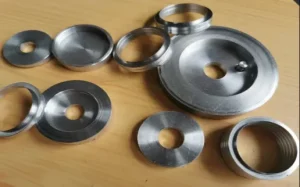
High-Precision Thin-Walled Inner Gear Rings
Nitrided high-precision components like these avoid distortion that ruins tooth profiles. The hard layer ensures wear resistance without quenching risks. Ideal for accuracy over depth, though cycles are longer. Lifespan extends in clean environments.
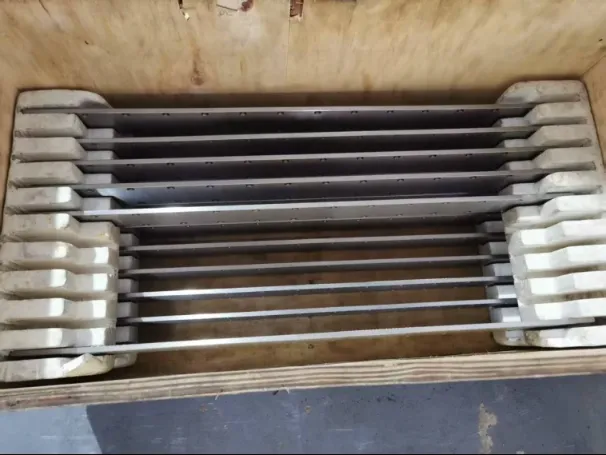
Sheet Metal Guides or Sliders
Depending on load and allowed warp, carburizing suits higher stresses with post-grind for fit. Nitriding works better for lighter duties needing corrosion edge. Balance budget against expected life—sometimes induction sneaks in for spots.
These cases highlight why no one-size-fits-all. Each prioritizes load, precision, cost, or lifespan differently.
What to Put on the Drawing: Specifying Surface Heat Treatment Clearly
Specifying surface heat treatment on engineering drawings prevents mix-ups.
Note the process: carburize, nitride, or induction-harden.
Add target hardness, say 58-62 HRC.
Include effective hardening depth.
Mark key areas or no-harden zones with masking needs.
Mention if post-grinding follows.
Heat treatment requirements on drawings guide suppliers. Case depth and hardness specification ensures parts meet intent. For processors like Deshibo, clear specs cut rework and streamline talks.
A vague drawing? That’s a recipe for delays.
Match the Process to the Part, Not the Other Way Around
No single surface heat treatment reigns supreme. It’s about fitting the method to the part’s needs and conditions.
Carburizing, nitriding and induction hardening each excel in spots. Weigh loads, precision, materials, and production to choose wisely.
Partner with experienced shops for heat treatment plus machining. It dodges costly trials.
In the end, smart picks keep components running smooth.
FAQ
Q: When should I choose carburizing for my parts?
Choose carburizing when you need high load capacity, deep case depth, and strong fatigue resistance.
Q: When is nitriding the best option?
Nitriding is ideal for precision parts requiring minimal distortion and high surface hardness.
Q: What parts benefit most from induction hardening?
Induction hardening fits components that need localized wear resistance, such as shaft journals, spline areas, gear teeth, and cam profiles.
Q: How do I select the right surface heat treatment for my component?
Evaluate load conditions, tolerance requirements, allowable distortion, material type, and whether only specific surfaces need hardening.
